
I wrote to Frank and Lisa after a long silence.
It was not really silence on my side. I had continued listening to Naked, Nudists, and Naturists, often during my naked morning workouts. But I had been pouring most of my energy into building The Nude House: shaping the editorial world, preparing books, developing the English and French sides of the work, and trying to create something more coherent than a succession of isolated posts.
Then two subjects from their recent episodes stayed with me. One was the pressure contained in the language of body positivity. The other was the future of naturist spaces and whether our community spends too much energy defending what remains instead of creating what should come next.
Frank and Lisa read my letter in episode 228 of Naked, Nudists, and Naturists. What followed became more than a mention of The Nude House. It became a thoughtful conversation about body neutrality, naturist confidence, building rather than merely defending, and the kind of culture naturism still needs.
The quiet relief of body neutrality
The sentence at the center of my letter was simple:
“Body neutrality feels like quiet relief: less pressure to celebrate or critique, just living comfortably without constant judgment.”
I have nothing against body positivity. It has challenged cruel standards and helped many people reject the idea that only certain bodies deserve visibility, pleasure or respect. That work matters.
But even a positive judgment keeps the body under judgment.
The mirror is still present. The question is still being asked. Is my body beautiful enough? Do I love it enough? Am I celebrating it correctly? Have I replaced a negative verdict with a sufficiently positive one?

Some mornings, I do not need to love my knees, admire my stomach or make peace with every sign of age. I need those parts of my body to carry me through a workout, into the shower, across a room and through the day. I can care for my body without turning it into a permanent emotional assignment.
That is the relief I find in body neutrality. The body is not condemned. It is not placed on a pedestal either. It is allowed to be a body.
What naturism gave me
In my letter, I described what happens after a few minutes of being naked:
“I stop thinking about my body altogether. I am just living.”
That is one of the great gifts naturism has given me.
People looking at naturism from the outside often assume it must increase attention to the body. Everything is visible, so surely everyone must become more conscious of appearance. The first moments can indeed feel that way, especially for a beginner. You may wonder where to look, what other people notice, whether you appear confident, and whether your body somehow reveals more about you than you intended.
Then, in a healthy naturist setting, ordinary life resumes.
Someone pours coffee. Someone complains that the chair is still wet. A towel slips from a shoulder. People discuss the weather, lunch, a book, the path to the beach, or whether the clouds will clear. Bodies differ visibly, but that difference gradually loses its dramatic charge.

You are not required to conclude that every body is beautiful. You discover something quieter: every body can belong to the scene.
This is why naturism can offer something that affirmations alone cannot. It is lived practice. The mind may still carry old judgments, but the body is already participating. You swim, walk, talk, read, work, cook or rest. Nudity stops being the main event because life has continued around it.
“You are okay with who you are, not what you look like”
Lisa made a distinction during the episode that stayed with me. She said that entering a naturist beach or resort may not come from body positivity at all. It may come from self-esteem: being okay with who you are, rather than needing to be satisfied with how you look.
That is an important difference.
It allows a person to want to become stronger, lose weight, gain weight, recover mobility, accept a scar, change an aspect of their appearance or change nothing at all. None of those choices needs to determine whether the person is worthy of respect today.
Frank approached the same point from another direction. If I say that I am positive about my appearance while continuing to think about it constantly, appearance still occupies the center of the room. Body neutrality offers the possibility of moving it aside.
The Cleveland Clinic’s explanation of body neutrality describes it as a middle position between loving and hating the body, grounded in acceptance and respect. The article also emphasizes function over appearance and the idea that the body is only one part of who a person is.
Writer and body-image coach Jessi Kneeland takes that decentering further. Her work asks what problems or emotional needs body-image struggles may be trying to solve, with the aim of removing the excess meaning attached to appearance.
These ideas deserve care. Body-image suffering can be profound, and naturism is not a medical treatment or a universal answer. But naturism can give some people an experience that is difficult to reach through argument alone: a period of time in which the body is visible without being made important.
Naturism without a body test
Body neutrality also changes the invitation we make to someone curious about naturism.
We do not have to tell them to love their body before they arrive. We do not have to ask them to become fearless, proud or transformed. We can say something far more believable:
You may arrive with doubts. You may still dislike parts of your appearance. You may feel awkward during the first minutes. None of that disqualifies you.
Choose a respectful place. Give yourself time. Notice what happens when nobody asks you to perform confidence. Let the real experience answer some of the fears built in advance.
The first victory may not be looking in the mirror and thinking, I am beautiful. It may be reaching the end of an afternoon and realizing that you barely thought about the mirror at all.
From defending naturism to building it
The second part of my letter moved from the individual body to the future of naturism.
We are losing spaces. Land is expensive. Public authorities can become cautious or hostile when the line between naturism and public sexual behavior is blurred. Communities spend time defending beaches, clubs and accepted practices that once seemed more secure.
Defence is necessary. But it cannot be our only posture.
I asked Frank and Lisa what might happen if we spoke more often about creating: new beaches, new places, sustainable operating models, and ways for naturists with experience in business, organizations or capital to become builders rather than occasional donors.
Lisa agreed strongly and pointed to Playa Sonrisa as an example of people applying real-world skills to create something that can endure. Frank compared the problem to a game in which a team does nothing but defend. Preventing the other side from scoring is not enough; at some point, you must build an attack of your own.
That is the same conviction behind The Nude House.
Naturist culture needs protection, but it also needs creation. It needs places, certainly. It also needs essays, stories, humor, mysteries, research, magazines and books. It needs work that assumes nude life is substantial enough to contain friendship, weather, memory, awkwardness, courage and change.
We cannot ask society to take naturism seriously while offering it only explanations of why we remove our clothes. We must also show what becomes possible once the explanation is over.
Hearing The Nude House through their eyes
After discussing my letter, Frank and Lisa opened The Nude House website and read from it at length.
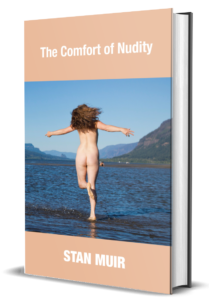
Listening to somebody else encounter words you have labored over is a strange experience. They paused over the idea of “body-honest writing that treats nudity with dignity rather than spectacle.” They explored the essays, fiction, paid room and growing book library. They remembered the Monroe Stone stories they had previously brought to life on the show. Then they visited the five-book nudism series on Amazon.
Their generosity moved me, but one comment from Lisa mattered especially:
“Every time I read anything he writes, I feel connected more with naturism.”
That is what I want the work to do.
Not persuade everyone. Not turn nudity into an endless campaign. Not manufacture outrage or pretend that every naturist experience is profound. I want the writing to help people enter naturism, understand it, live it more fully and recognize a little more of themselves within it.
Sometimes that means practical guidance. Sometimes it means a story. Sometimes it means finding a quieter phrase for something many of us have felt but not named.
Body neutrality may be one of those phrases.
The body can return to the background
I am grateful to Frank and Lisa for taking my letter seriously, for giving The Nude House so much of their time, and for following the idea of body neutrality beyond my original paragraph.
Their conversation did not close the subject. It opened it.
Perhaps that is the most useful way to understand the relationship between naturism and body neutrality. Naturism does not require us to reach a final verdict on our bodies. It gives us places and practices in which the verdict can become less urgent.
The body remains present. It carries us. It changes. It asks for attention when it is cold, tired, hungry, ill or joyful. But it does not have to remain the subject of every moment.
Sometimes the deepest form of body freedom is simply forgetting to evaluate it.
Listen to NNN episode 228 on Spotify and visit Naked, Nudists, and Naturists for more conversations from Frank and Lisa.
If you want a calm, practical path toward experiencing naturism for yourself, continue with Becoming a Nudist.
Get Nude, Stay Nude, Live Nude and Share the Nude Love!

The body of everyone is their own story. Each time I am able to be nude with others, it means a very joyful experience to me. This is because I don’t think of bodies as objects to critique, but as stories set in the way of how the body is. My body tells my story and though at times I have wanted some parts to be different, as I have lived more and more as a nudist, I have found not only acceptance of my body by me, but have come to just enjoy living as a person who is loved by God and nature, by others, and just who I am. My body is one part of who I am and sometimes it is a very important part, but it never is the whole. So the wonderful and amazing life as a nudist is well worth seeing life in all its fullest glory before God and humans.