
The realization hit me on a completely ordinary day, standing on a textile beach with my wife. I wasn’t naked. I wasn’t in a naturist setting. I was simply wearing a tiny thong—a sliver of fabric that felt far smaller than my confidence in that moment. At first, every movement made me hyper-aware of myself. I could almost feel my own thoughts tugging at the waistband: People must be looking… Is this too much? Do I look ridiculous?
My wife watched me with that gentle, amused knowing that long-time partners have. We chatted, and somewhere in that conversation I understood something simple but life-changing: if I kept my mind glued to the idea that I was exposing “too much,” I’d never relax. But if I let my mind drift to something else—the breeze, the waves, her voice, the warmth of the sun—my self-consciousness dissolved. I started standing differently. I breathed more deeply. I walked without rehearsing each step.
Nothing about the thong changed. My mindset did.
And that shift reminded me of something I’ve seen over and over again in naturist spaces: comfort begins when we stop monitoring ourselves. Naturism isn’t about being naked—it’s about abandoning the mental spotlight that keeps us tense, guarded, or worried about how we look. Whether it’s a thong on a textile beach or complete nudity among naturists, the mechanism is the same. When you stop thinking about your body, you start living fully in it.
When we talk about self-consciousness in naturism, we’re really describing a tension between two states: the internal gaze and the external world. When you’re new to nudity—whether fully naked at a naturist beach or wearing a tiny thong on a textile beach—your mind is buzzing with monitoring: How do I look? What are people thinking? Am I doing something wrong? That inner noise is what blocks comfort.
But seasoned naturists know something liberating: once you let go of that inner surveillance, nudity becomes as ordinary as breathing. The moment you stop thinking about your own nudity is the moment naturism clicks.
I’ve experienced it countless times, and I’ve seen it in others: the transition from conscious nudity to natural nudity is instant and unmistakable. Shoulders drop. Breathing deepens. Movements become fluid rather than controlled. It’s like stepping out of the spotlight and realizing there never was a spotlight at all.
It’s the same mechanism when someone wears a thong at the beach. If you feel hyper-aware, tugging at it, adjusting it, wondering who’s watching, you’re not really in your body—you’re stuck in your head. But once you abandon that self-consciousness and simply walk, swim, laugh, or lie down without thinking about the fabric (or lack thereof), you’re just living. And interestingly, people around you tend to mirror that ease.
I’d argue that naturism actively teaches this skill. By being fully naked, you confront every conditioned fear society has drilled into us about bodies, appearance, comparison, and judgment. You walk straight into the fire—only to discover it’s not fire at all, just warm sunlight. That realization is powerfully transformative. It builds confidence, resilience, groundedness.
Here are a few angles you could weave into the piece:
1. Self-consciousness is a learned response, not a natural one.
Children don’t monitor their bodies the way adults do. Naturism helps us return to a more innocent way of being—free from the internal critic.
2. The body becomes functional rather than performative.
When you stop treating your body as an object to be evaluated, it becomes part of your life again—moving, stretching, swimming, feeling.
3. Comfort comes from congruence.
If part of you wants to be nude but another part is terrified of what others think, you’re at war with yourself. Letting go aligns intention with action.
4. Confidence is the byproduct, not the prerequisite.
People often think they need confidence to get naked. In reality, getting naked teaches confidence.
5. Thongs, toplessness, or full nudity all trigger the same mechanism.
It’s not about how much you’re wearing. It’s about how much your mind is interfering.
6. Naturism is a practice of relaxed presence.
You’re not trying to impress, hide, compare, or compete. You’re just there—bare and real.
And the beautiful irony? The minute you stop being self-conscious, nobody else is conscious of you either. The world becomes a place where naked bodies are simply bodies.
This is what makes naturism such a profound teacher. It’s not just about being nude; it’s about learning to live comfortably in your skin—literally and metaphorically.
Get Nude, Stay Nude, Live Nude and Share the Nude Love!


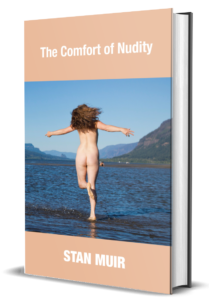

My husband had been a nudist since youth. This is the second marriage for us both. I had never been a nudist except at home with him which was a comfort never before experienced. So when he suggested we go to a nude resort I thought he was nuts. But I relented and we went. Yes I was scared, I wouldn’t look good enough, everyone would stare at me, all the men would want me to look at their penises. None, I mean, zero of that happened. After an hour I was hooked and have been ever since. It’s the only way to live.
Ms. K
Thank you so much for your comment!
I never thought about nudism, I didn’t think I’d become one, much less try it. It all happened during a casual conversation with another nudist; after several attempts, he convinced me to try it at home. I thought it was something crazy and that only exhibitionists could do such things. However, when, after several hours of home nudity, I put clothes back on, I noticed how uncomfortable and bothersome they were. Underwear elastic bands, buttons, straps, etc.—that day, I understood why nudists undressed. After a few days of resistance, I began undressing regularly and spending more and more time naked. I became a nudist and a nudist addict in just a few days. A year later, I started living naked and I’m happy with how nudism has transformed me and my life. Only naked; I couldn’t live otherwise.
Thank you for sharing your journey—it’s inspiring to hear how quickly you discovered the comfort and freedom of living nude at home, and how it transformed your daily life for the better.
Stories like yours show just how natural and addictive that sense of liberation can be once you experience it.